Growth Is Making Your Business Harder — Here's Why
Apr 17, 2026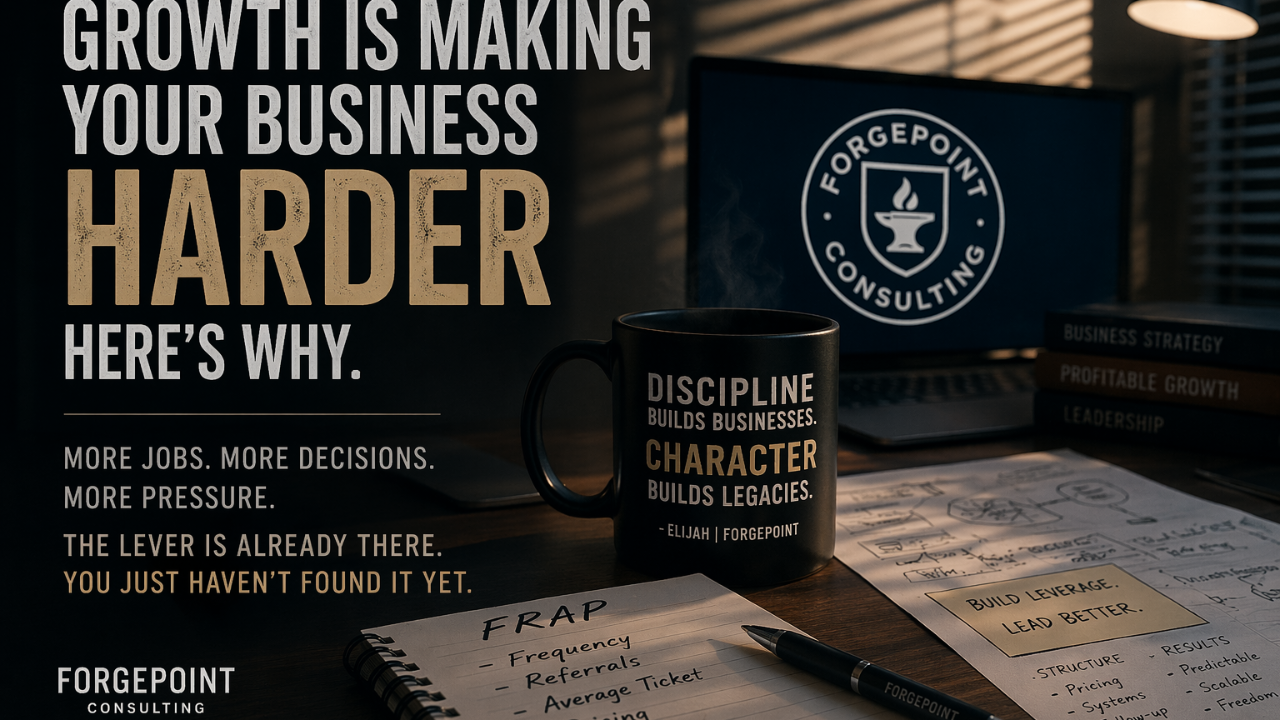
Growth Is Making Your Business Harder — Here's Why
Most businesses do not fail because they cannot get customers. They struggle because the business gets heavier as it grows.
More jobs. More decisions. More pressure landing squarely on the owner's shoulders. At first, growth feels like progress. Then something shifts. Revenue is higher than it has ever been—and the company is harder to manage, harder to step away from, and harder to lead.
This is what happens when growth outpaces structure.
The Tool Will Not Save You
AI, software, automation, and better tools can all help. But they do not fix a business that only works when the owner is in it. They amplify what already exists. Structure becomes more scalable. Chaos becomes faster chaos.
I learned this while building my own contracting company. Demand grew, revenue increased, and the company became nationally recognized—but growth also exposed every weakness in pricing, systems, accountability, and leadership capacity.
The business did not need more of me. It needed better economics and a stronger operating structure beneath me.
You Are Not Stuck. You Are Carrying Too Much.
Most owners are trying to move the business with their hands. They solve every problem, answer every question, and personally create the momentum.
That works until the company becomes so dependent on the owner that growth starts feeling like a trap.
The leverage is usually already inside the business. The owner simply needs a way to see it and a structure for acting on it.
The Profit Levers Inside the Business
FRAP stands for Frequency, Referrals, Average Ticket, and Pricing. These four levers help owners identify where revenue and profit are being lost or left undeveloped.
- Frequency: Are customers returning, renewing, or buying as often as they reasonably could?
- Referrals: Is new business generated intentionally through customers and strategic partners?
- Average Ticket: Is the company creating and capturing enough value in each transaction?
- Pricing: Does the price support healthy margins and strong delivery?
The framework is universal. ForgePoint primarily applies and markets it to contractors and local service companies, but the underlying economics are relevant across industries.
Why Working Harder Stops Working
Effort does not create leverage. Structure does.
Without structure, growth increases complexity, revenue increases pressure, and success increases owner dependence. With structure, the company becomes more measurable, more repeatable, and less reliant on the owner holding everything together.
That is the shift ForgePoint is built to help create.
There Is More Than One Right Path
Profit Momentum Consulting is the hands-on path for established contractors and local service companies that need direct help improving both the Profit Engine and Operating Engine.
The Forge is ForgePoint's Houston FRAP Chapter. A FRAP Chapter is the generic model; The Forge is the local name. It is open to owners from any industry and is often a strong fit for smaller companies, owners who are not ready for the investment or intensity of PMC, and people who need a practical room for education, accountability, and implementation.
The right answer depends on the size of the company, the urgency of the problem, and how much direct implementation support is needed.
Choose the Right Starting Point
Compare the available paths on the Work With ForgePoint page.
For the smaller-group FRAP path, learn more about The Forge.
When the right path is not obvious, talk through the bottleneck.
Discipline builds businesses. Character builds legacies. — Elijah | ForgePoint