
Your Contractor Business Doesn’t Need More Leads—It Needs a Better Follow-Up System
Sep 20, 2026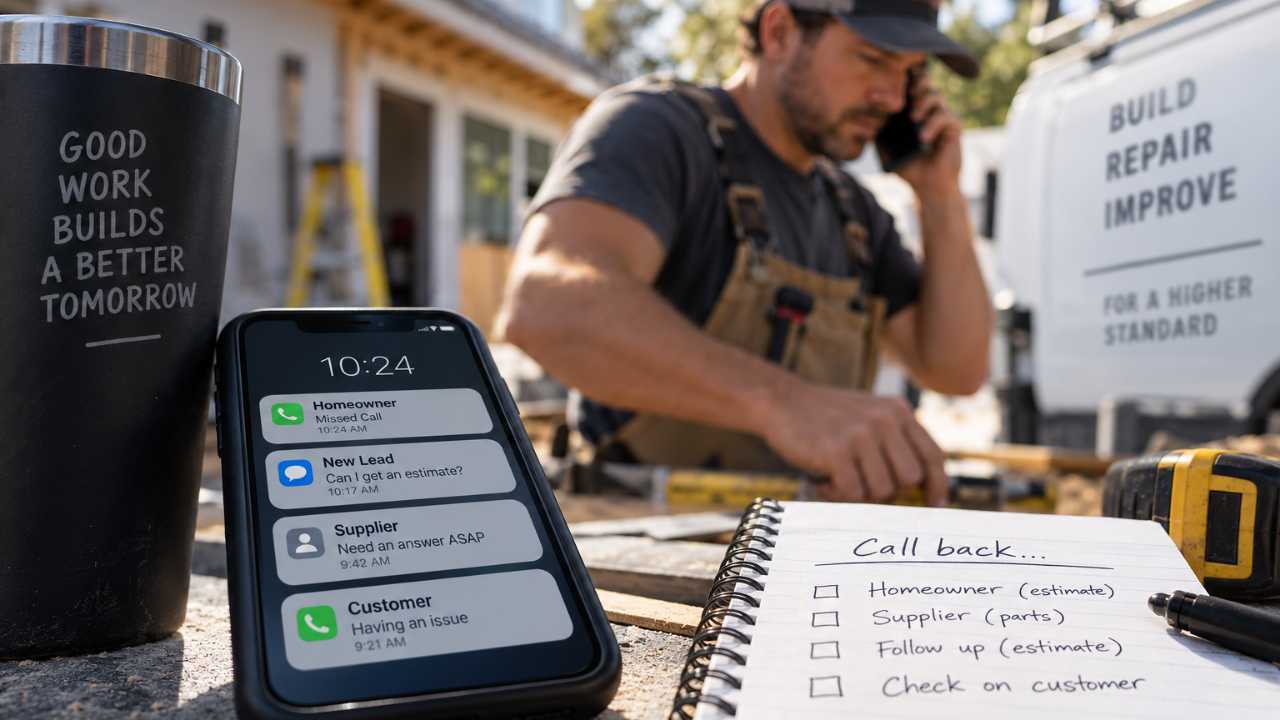
The phone rings while you are on a job. A homeowner wants an estimate. You tell yourself you will call back when you get to the truck.
Then a supplier calls. One of your technicians needs an answer. A customer has a problem. The day gets away from you.
Three days later, you remember the lead—but by then, another contractor has already followed up, answered the customer’s questions, and scheduled the work.
The natural response is to think, We need more leads.
But many contractors do not have a lead-generation problem. They have a lead-management problem.
More advertising will not fix that. It will simply send more opportunities into the same broken process.
The real cost of weak follow-up
A missed follow-up does not look dramatic. Nothing breaks. No alarm sounds. The opportunity simply disappears.
That makes lost leads easy to underestimate.
According to Jobber’s 2026 Home Service Trends Report, more than 70% of customers expect a same-day response, and more than half expect a response within an hour. Yet only 20% of home-service businesses report responding to new leads within that first hour. Jobber also found that higher-earning businesses tend to respond faster because they use structured systems and automation.
That gap is not just a customer-service issue. It is a revenue issue.
Contractors commonly lose money in at least five places:
- The initial inquiry is never returned.
- The estimate is sent, but nobody follows up.
- The customer says “not yet,” and the opportunity is forgotten.
- Responsibility for the next step is unclear.
- The owner is the only person who knows the real status of the lead.
When that happens, the business pays twice. It loses the potential sale, and it wastes the time or money already spent generating the opportunity.
Before you buy more leads, answer these five questions
You do not need a complicated report to identify the first signs of a follow-up problem. Start with five questions:
- How many open leads do you have right now?
- How many estimates are waiting for a decision?
- Who owns the next action on each opportunity?
- What date is each follow-up due?
- How many opportunities have received no contact in the last seven days?
If those answers live in your memory, your text messages, a legal pad, several inboxes, or inside the heads of different employees, you do not have a reliable pipeline.
You have scattered information.
That distinction matters. A list tells you who contacted the business. A pipeline tells you what must happen next to move each opportunity toward a decision.
The owner is often functioning as the follow-up system
In many growing contractor businesses, the owner becomes the connection between everything.
The owner remembers which customer needs a revised estimate. The owner knows which proposal needs another call. The owner decides whether the lead is worth pursuing. The owner steps in when an employee does not know what to say.
That approach can work when the company is small. It can even feel like excellent customer care because the owner stays personally involved.
But as lead volume, job count, and team size increase, personal involvement turns into organizational dependence.
The business does not have a follow-up system. It has an owner trying to remember everything.
This is where I encourage owners to look at a number that most financial statements never show clearly: Owner Profit per Hour.
At its simplest, Owner Profit per Hour asks:
After accounting for what the business actually produces for you, how much are you earning for every hour the company requires from you?
Revenue alone cannot answer that question. A company can grow from $500,000 to $1 million in sales while the owner works more hours, carries more stress, and takes home very little additional profit.
If you are spending evenings searching through text messages, rebuilding lead lists, chasing estimates, and personally rescuing every stalled opportunity, those hours are part of the real cost of your follow-up process.
More leads may increase revenue while reducing your Owner Profit per Hour.
That is not healthy growth. It is a more demanding version of the same constraint.
A CRM cannot repair an undefined process
When follow-up begins failing, owners are often told to buy a customer relationship management system.
A CRM can help—but software is not the first decision.
Before choosing a platform, define the operating process the platform must support:
- What qualifies as a lead?
- Where is every lead entered?
- Who is responsible for the first response?
- How quickly must that response happen?
- What stages does an opportunity move through?
- What follow-up cadence occurs after an estimate?
- When is an opportunity considered lost?
- Who reviews open opportunities and how often?
Without those answers, the business usually turns an expensive CRM into another incomplete contact list.
The rule is simple: process before platform.
You need one reliable way to capture an opportunity, assign responsibility, identify the next action, and make missed follow-up visible.
That system could begin with software you already own. Complexity is not the goal. Reliability is.
The Lead-to-Revenue Gap
I use the term Lead-to-Revenue Gap to describe the space between customer interest and collected revenue.
Every unnecessary delay, unclear handoff, forgotten task, and unreturned estimate widens that gap.
The gap usually has four parts:
1. Capture
Can the business reliably record every phone call, website inquiry, referral, social-media message, and in-person opportunity in one place?
2. Ownership
Does every lead have one person responsible for the next action, or does everyone assume somebody else is handling it?
3. Movement
Can you see whether the opportunity is new, contacted, scheduled, estimated, awaiting a decision, won, or lost?
4. Accountability
Does someone review overdue actions and open estimates on a consistent schedule?
Most follow-up problems can be traced to a breakdown in one or more of these four areas.
This is also why “work harder” is weak advice. The owner and team may already be working hard. The problem is that the process depends on attention and memory instead of visible ownership and repeatable actions.
A simple contractor follow-up system
A useful contractor lead follow-up system does not need dozens of stages or complicated automation. It needs to answer five questions at a glance:
| Field | Question it answers | |---|---| | Lead or customer | Who is the opportunity? | | Pipeline stage | Where does the opportunity stand? | | Opportunity value | What could the work be worth? | | Next action and owner | Who must do what next? | | Follow-up date | When must it happen? |
From there, establish a basic rhythm:
Respond quickly
Set a clear standard for the first response. Even when you cannot provide an immediate estimate, acknowledge the inquiry and tell the customer what happens next.
Follow up consistently
Do not interpret silence as rejection. Customers get busy, compare options, wait on spouses or business partners, and postpone decisions. A professional follow-up is service, not desperation.
Make the next action specific
“Follow up later” is not an action. “Call Tuesday to answer the financing question” is an action.
Review the pipeline weekly
Hold a short review of new leads, open estimates, overdue follow-ups, stalled opportunities, and lost jobs. The purpose is not to create another meeting. It is to keep revenue from becoming invisible.
Track why work is lost
Price is not the only reason customers say no. Track whether the customer chose a competitor, delayed the project, stopped responding, disliked the schedule, or never received adequate follow-up. Patterns reveal where the real constraint lives.
Better follow-up is not about pestering people
Some contractors resist follow-up because they do not want to sound pushy.
That concern is understandable. Nobody wants to become the salesperson who calls every day and refuses to hear “no.”
But professional follow-up is not pressure. It is clarity.
A useful follow-up can:
- Confirm that the customer received the estimate.
- Ask whether any part of the proposal needs clarification.
- Explain the difference between options.
- Set expectations about scheduling or pricing.
- Give the customer permission to say the timing is not right.
The goal is not to chase every person forever. The goal is to make sure good opportunities do not die because the business failed to communicate.
Why this is usually bigger than a sales problem
When I look at a contractor’s follow-up process, I am rarely looking only at sales.
The pipeline often exposes deeper constraints:
- The owner has not delegated decision-making.
- Roles are unclear.
- The company lacks a weekly operating rhythm.
- Estimating takes too long.
- Pricing is inconsistent.
- Nobody knows which numbers matter.
- The team has tools but no shared process.
That is why installing a lead tracker may improve visibility without solving the entire problem. The most important constraint may sit somewhere else in the business.
If estimates take ten days because all pricing depends on the owner, faster lead capture will not solve the bottleneck. If the business wins plenty of work but prices it poorly, a higher close rate may create more activity without creating more profit. If employees cannot act without permission, automation will only move the delay to a different stage.
The right question is not simply, “How do we get more leads?”
It is:
What constraint is preventing the opportunities we already have from becoming profitable, well-delivered work?
Run this 15-minute follow-up audit
Before spending more money on marketing, take 15 minutes and do the following:
- List every known open lead and outstanding estimate.
- Assign a dollar value where reasonably possible.
- Identify the last contact date for each one.
- Write down the next action, responsible person, and due date.
- Mark every opportunity that has gone more than seven days without movement.
- Estimate how many owner hours are spent each week finding information, reminding people, and personally moving leads forward.
The exercise will not tell you everything, but it will make two hidden costs more visible: revenue sitting unattended and owner time being consumed by an unreliable process.
That is the beginning of understanding your Owner Profit per Hour—and whether the company is truly serving you or simply demanding more from you.
The next step is finding the real constraint
Your contractor business may genuinely need more leads. But you should prove that before buying them.
First, determine whether the opportunities already entering the company are being captured, owned, advanced, and reviewed. Then look beyond the pipeline to determine whether leadership, pricing, estimating, staffing, financial visibility, or operational systems are limiting profitable growth.
That is the purpose of ForgePoint Consulting’s Contractor Constraint Diagnostic.
The Contractor Constraint Diagnostic is a focused, two-hour working session designed to identify the primary constraint holding the business back, show how that constraint affects profit and owner capacity, and establish practical priorities for addressing it.
It is not a generic consultation or a software demonstration. It is a structured examination of where the business is losing momentum—and what the owner should address first.
If you are generating work but still carrying too much of the company personally, start by asking what your time is really producing.
Your revenue may tell you how large the business has become. Your Owner Profit per Hour will tell you whether that growth is working for you.
Schedule a Contractor Constraint Diagnostic
Frequently Asked Questions
How quickly should a contractor respond to a new lead?
As quickly as the business can respond reliably and professionally. Current home-service research shows that more than half of customers expect a response within an hour, while more than 70% expect one the same day. Even if you cannot immediately provide an estimate, acknowledge the inquiry and explain the next step.
How many times should a contractor follow up on an estimate?
There is no universal number for every trade or project size. The business should establish a consistent cadence that provides helpful contact without pressuring the customer. Each follow-up should have a purpose, such as confirming receipt, answering questions, clarifying options, or determining whether the project has been postponed.
Does a small contractor need a CRM?
A small contractor needs a reliable lead-management process. A CRM may support that process, but the system can begin with a simple shared tool if it consistently records the lead, pipeline stage, responsible person, next action, and follow-up date.
What is Owner Profit per Hour?
Owner Profit per Hour is a practical way to evaluate what the business produces for the owner relative to the time it requires from the owner. It helps expose situations where revenue is growing but profit, freedom, or owner capacity is not improving proportionally.
What is a Contractor Constraint Diagnostic?
ForgePoint Consulting’s Contractor Constraint Diagnostic is a paid, two-hour working session that examines the business to identify the primary issue limiting profitable growth or owner capacity. The outcome is greater clarity about the constraint, its business impact, and the priorities for addressing it.